
The Thursday Question 3.22: Breaking up is hard to do, and even harder to cost
What were the "costs" of Brexit? What does that mean for Alberta?

Always a pleasure to be on CBC’s West of Centre with Kathleen Petty, last week with Sean Speer. We got great feedback about our discussion of the separation debate and its impact on the UCP and federal Conservatives. Listen here.
There is also a new drop of The Chiefs panel on The Herle Burly. We all get along in person, which let us go right at it on the Carney agenda, how governments use the summer, Alberta separation, and USMCA. And on some event called Eurasia?? Listen here.
This week marks the tenth anniversary of the Brexit referendum. That narrow Leave vote began the UK’s departure from the EU. Over the weekend, Brexit opponents lined up to provide their “I-told-you-sos” on air (1). Coincidentally, Brexit impresario Nigel Farage was also on air, but in his case speak about the resignation of the sixth British prime minister since the vote.
The “I-told-you-so” case was buttressed by an updated paper from the National Bureau of Economic Research on the economic impact of Brexit (2). The paper’s co-authors, a group of university and central bank economists, summarized their findings as follows:
This paper examines the impact of the UK’s decision to leave the European Union (Brexit) in 2016. … [W]e combine estimates using macro data with estimates using micro data collected through our Decision Maker Panel survey. These suggest that by the end of 2025 Brexit had reduced UK GDP by 6% to 8%, with the impact accumulating steadily over time. We estimate that investment was reduced by 12% to 13%, employment by 3% to 4% and productivity by 3% to 4%. These negative impacts reflect a combination of elevated uncertainty, reduced demand, diverted management time, and increased misallocation of resources from a protracted Brexit process. Comparing these with contemporary forecasts shows that these forecasts were relatively accurate in the short to medium term, but they underestimated the impact over a decade.
There you go. Brexit had “negative impacts”. It shrank the UK’s GDP, hurt investment, cut employment and lowered productivity. Experts warned about it at the time. You should have paid attention. Zakaria repeated the claim on Sunday.
But the basic data available through the OECD shows a different story. Britain’s economy has done decently well since Brexit. In fact, for the last twenty-five years, Britain’s per capita GDP has closely tracked that of France (3). The two nations started the 21st century tied on this measure, they were tied through the Brexit process, and remain tied today. One left the EU and the other remained. Look at the graph of per capita GDP and see if you can spot the impact of Brexit. I cannot.
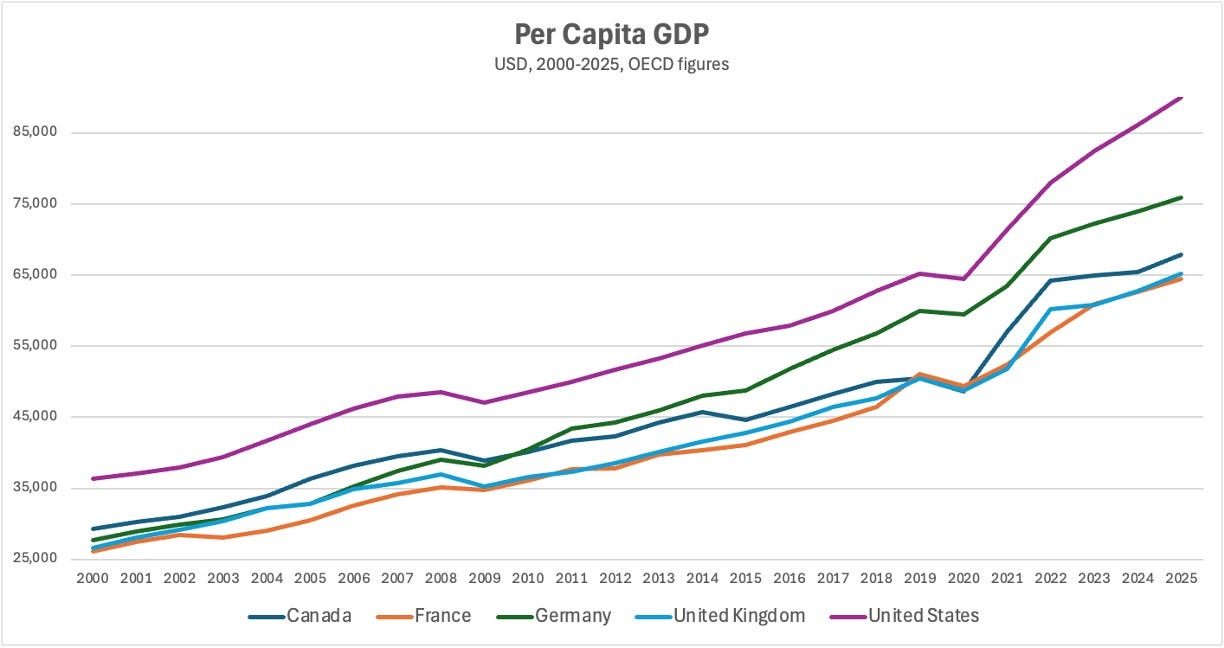
Certainly, Germany has grown faster than the UK. It has also grown faster than France. The US has powered ahead of all three. But you need an awful lot of expert massaging with “macro estimates” and feedback from the “Decision Maker Panel” to make it look like Brexit reduced the British economy by 6-8%.
Which leads to the headline’s conceptual problem. Would the UK have done better under different policies than the ones it adopted in recent years? Maybe. But Brexit itself was simply an event. A decision. British policy makers have made thousands of decisions since then, as have the leaders of its main trading partners. Taken together, they also influenced the UK economy. Who deserves credit, or blame, for what has taken place since 2016?
Some Brexit campaigners hoped that, once the UK was liberated from EU decisions and the EU’s crazy scheme of fiscal transfers, it would become a northern Singapore by liberalizing regulation, reducing taxes, and boosting living standards. The six UK governments since 2016 have not followed that path, and the Starmer government’s decision to hike taxes while leaving government unreformed will not make things better. Those governments could have liberalized, and things might have turned out even better. But the economic consequences of Brexit have been downstream of the statecraft – the politics – of the process. They were not inherent in Brexit.
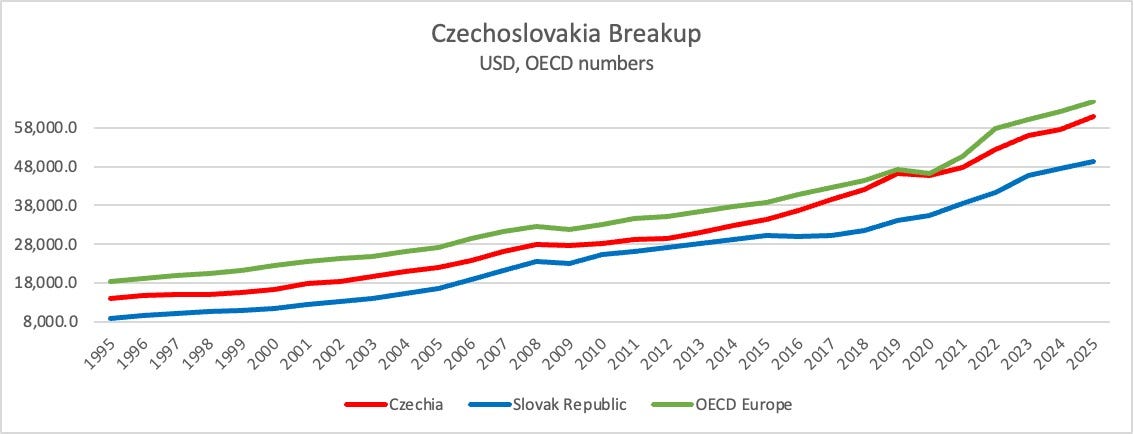
This becomes clearer with a less controversial example. The Czech Republic and Slovakia have taken different paths since they split in 1993. The Czech Republic has trended up to EU standards of per capita GDP, while Slovakia has lagged. Which outcome is the result of the split? Which is the result of good economic policy?
Or take any of the dozens of other examples drawn from the 20th century’s decolonizations. Many former colonies became independent countries. Some did better economically than others. Is decolonization to be blamed for the laggards the fault or to be credited for the successful?
These are pointless questions, designed to keep ivory tower seminars busy. Keep that in mind as Albertans approach the October referendum.
Three weeks ago, Premier Danielle Smith suggested that it would cost Alberta $400 billion to leave Canada (CBC News, “Alberta premier warns separation could cost $400B,” June 3, 2026). She cited the costs of duplicating Canadian policies on national defence, OAS, etc. And she might be right. There will be costs involved in separating.
What assumptions lie behind that $400 billion figure?